Our brand is named after an ingredient, which means I get asked fairly often whether that was a marketing decision.
It wasn’t.
It was a formulation one.
And no, I don’t believe an ingredient becomes appropriate for African skin simply because it comes from Africa.
The ingredient still has to earn its place in the formula.
When you’re choosing oils for skincare intended for melanin-rich skin in a hot, humid climate, you are solving for several things at once. Most oils are good at some of them and less suited to others.
So this is the honest version of why marula oil earned its place in my formulations—and what I look for when choosing an oil.
What Marula Oil Is
Marula oil is obtained from the seeds of the marula fruit, Sclerocarya birrea, a tree native to parts of southern and eastern Africa.
It is an oleic-rich botanical oil. In one published analysis of marula oil, oleic acid accounted for about 69% of the oil’s fatty acid composition, making it the dominant fatty acid in that sample.
That matters because an oil’s fatty acid composition is one of the characteristics that influences how it behaves as part of a formulation.
But composition isn’t the only thing I consider.
How the oil feels, how it behaves over time, how it works alongside other ingredients, and whether the finished product makes sense for the person using it all matter too.
Why the Fatty Acid Profile Matters
Marula is an oleic-rich oil with conditioning and emollient properties.
Our supplier also describes the marula oil we source as readily absorbed and non-greasy. The Formulator Shop — Marula Oil
For skincare intended for hot, humid conditions, that isn’t simply a comfort preference.
It is a performance consideration.
You are not formulating for a laboratory shelf.
You are formulating for real skin, in real heat, in real humidity.
An oil can look beautiful on an ingredient list and still be abandoned by 10am because it feels too heavy.
And a product nobody wants to wear consistently provides very little practical value, regardless of how interesting the ingredient looks on paper.
This is one of the reasons sensory experience matters so much to me when formulating.
What I look for: the source and processing of the oil, its composition, its sensory characteristics, and how it behaves within the finished formula.
Oxidative Stability, and Why It Matters More Here
This part rarely appears in marketing copy, but it matters in formulation.
Oils can oxidise over time. Oxidation can change an oil’s smell and composition, and the rate of oxidation is influenced by factors including the fatty acid profile, temperature, light and storage conditions.
In general, oils containing higher proportions of polyunsaturated fatty acids are more susceptible to oxidation than oils dominated by more oxidation-stable fatty acids. Heat can also accelerate oxidative processes.
Marula is described by our supplier as a stable oil containing natural antioxidants. The Formulator Shop — Marula Oil
For a product being stored and used in Lagos rather than a temperature-controlled European warehouse, that is a characteristic worth considering.
But stability isn’t something I would attribute to one ingredient characteristic alone.
The finished formula, packaging, processing and storage conditions all matter.
That’s why formulation doesn’t end when you’ve chosen an interesting oil.
What I look for: appropriate supplier storage, suitable packaging, sensible formulation choices and good manufacturing practices that support the stability of the finished product.
Conditioning Without the Weight
An oil should do more than look impressive on an ingredient list.
It needs to contribute to the way the finished product feels and performs.
Marula’s fatty acid profile makes it an interesting emollient oil for formulations where conditioning and a wearable finish are both important considerations. Published research on marula oil has also evaluated its moisturising, occlusive and barrier-related effects when applied topically.
And this is where the conversation becomes particularly relevant to melanin-rich skin.
When skin becomes inflamed or injured, post-inflammatory hyperpigmentation can develop. PIH is especially common in darker skin tones and can be persistent once it develops.
That doesn’t mean marula oil is a treatment for hyperpigmentation.
It isn’t.
The point is that comfortable, well-tolerated skincare matters.
If a product is unnecessarily irritating, uncomfortable or difficult to use consistently, that can become a problem for any skin type and inflammation can be particularly consequential for skin that is prone to PIH.
So when I formulate for melanin-rich skin, I don’t only think about what an ingredient is supposed to do.
I think about how the finished product behaves on skin.
An Oil Is One Part of a Routine, Not the Whole Routine
This is worth being clear about because facial oils are frequently oversold.
An oil primarily functions as an emollient and can help reduce transepidermal water loss by contributing to an occlusive layer on the skin.
It does not do the same job as a water-based hydrator.
It does not replace targeted treatment ingredients.
And it does not replace sun protection.
Marula can be a useful part of a formulation. It is not a complete skincare routine.
That distinction matters to me because good skincare education should explain what an ingredient can reasonably contribute, not turn every botanical into a miracle.
There isn’t one miracle ingredient.
The Reason That Isn’t Chemistry
There is one more reason marula became part of our story, and it has nothing to do with fatty acids.
It is an African botanical.
And that matters to me.
But not because I think we should put African ingredients into bottles simply to make skincare feel more African.
It matters because there is value in building formulations around botanicals rooted in this continent, while still evaluating them by the same principles I would apply to any other ingredient.
Origin can be meaningful.
But origin alone isn’t a formulation rationale.
That’s the distinction I keep coming back to.
Not whether an ingredient is impressive.
Not simply where it comes from.
But whether it is right for where the product will actually be used.
And perhaps that is also why marula became part of our name.
Frequently asked questions
Is marula oil good for oily or acne-prone skin?
Marula is an oleic-rich oil with a readily absorbed feel, but whether a facial oil suits oily or acne-prone skin varies from person to person and depends on the overall formulation. An oil that feels comfortable on one person’s skin may feel too rich for another. If you’re introducing a new facial oil, patch testing and starting gradually are sensible approaches.
Is marula oil good for dark skin specifically?
Marula oil isn’t specifically proven to treat pigmentation simply because it is used on dark skin. Its relevance to our formulations comes from its properties as an emollient botanical oil and how it can contribute to the feel and performance of a finished formula. For melanin-rich skin, we also pay close attention to avoiding unnecessary irritation because inflammation can contribute to post-inflammatory hyperpigmentation, which is more common in darker skin tones.
Refined or unrefined marula oil?
We choose cold-pressed, minimally processed marula oil because we want to work with the oil’s natural characteristics. That doesn’t mean refined oils are inherently inferior. Refining can be useful when a formulator needs a particular colour, odour, purity or other specification. The right choice depends on the purpose of the formulation and the characteristics required from the finished product.
Can I use marula oil on its own?
You can, but we think of facial oil as one part of a skincare routine rather than the whole routine. An oil can condition the skin and help reduce water loss. It does not replace hydration, targeted treatment or sun protection.
Does marula oil treat hyperpigmentation?
Marula oil should not be presented as a treatment for hyperpigmentation. Its role in our formulations is primarily as part of an emollient oil blend. For concerns such as hyperpigmentation, the overall routine including appropriate treatment ingredients and daily sun protection is much more important than relying on a single botanical oil.
Which Marula Green Beauty product contains marula oil?
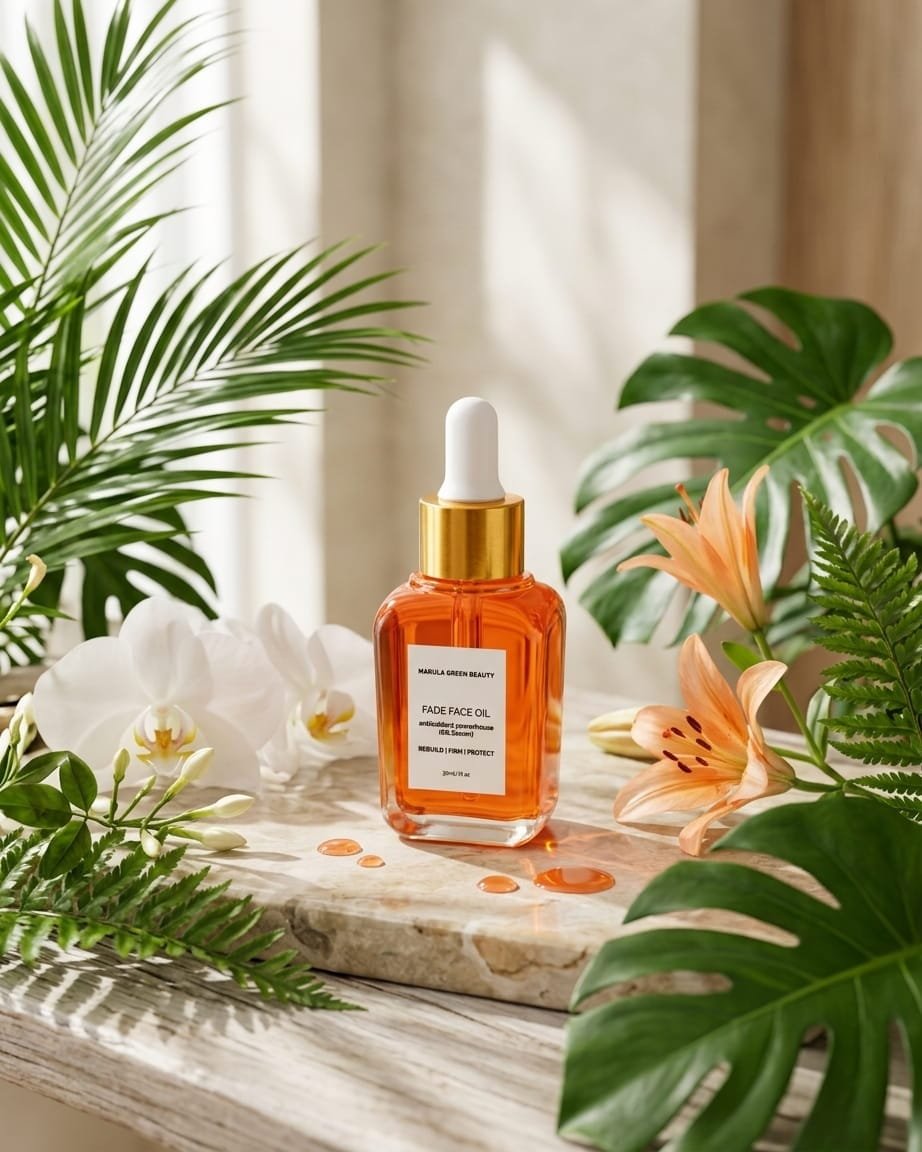
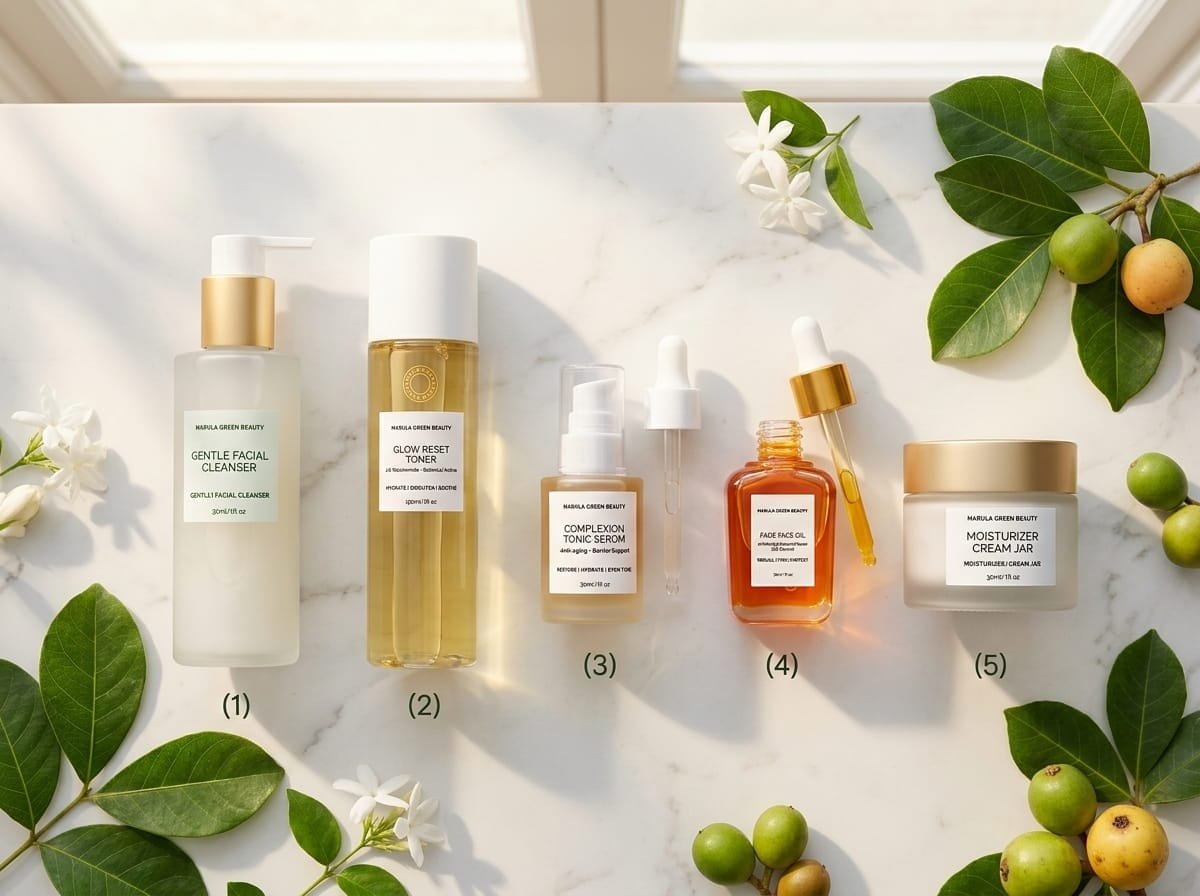
You will find marula oil in our Fade Face Oil. It isn’t there as a single “hero” ingredient expected to do everything. It is one component of a broader formulation designed to work as a whole.
Formulated Around It, Not Just Named After It
 Marula oil is in our Fade Face Oil because of what it can contribute to the formulation—not simply because of how it sounds on a label.
Good formulation is rarely about finding one hero ingredient.
It is about making the whole formula make sense.
For the skin. For the climate. For the person who has to live with the product on their face. And for the reason the product exists in the first place.
Sources & Further Reading
1. Marula oil composition and topical performance
Marula oil has been studied for its fatty acid composition and topical properties. One clinical study found oleic acid to be the predominant fatty acid in the tested marula oil and evaluated moisturising, occlusive, barrier and tolerability outcomes following topical application.
Safety and efficacy of Sclerocarya birrea (A.Rich.) Hochst (Marula) oil: A clinical perspective
2. Post-inflammatory hyperpigmentation in darker skin
PIH is a common consequence of inflammatory skin conditions and occurs more frequently in people with darker skin.
Post-inflammatory hyperpigmentation: A comprehensive overview — Journal of the American Academy of Dermatology
3. PIH and skin of colour
A 2024 systematic review found that PIH has a heightened predilection for darker skin tones and is frequently associated with inflammatory conditions.
Treatment of Post-Inflammatory Hyperpigmentation in Skin of Colour — PubMed
4. Inflammation and PIH in dark skin
This review examines the molecular mechanisms linking inflammation and post-inflammatory hyperpigmentation in darker skin.
Post-Inflammatory Hyperpigmentation in Dark Skin: Molecular Mechanism and Skincare Implications — PubMed
5. Marula oil specification
The marula oil used by Marula Green Beauty is sourced from The Formulator Shop, whose product description identifies it as Sclerocarya birrea (Marula) Seed Oil and describes it as an oleic-rich, stable oil with natural antioxidants and a readily absorbed, non-greasy feel.
The Formulator Shop — Marula Oil