
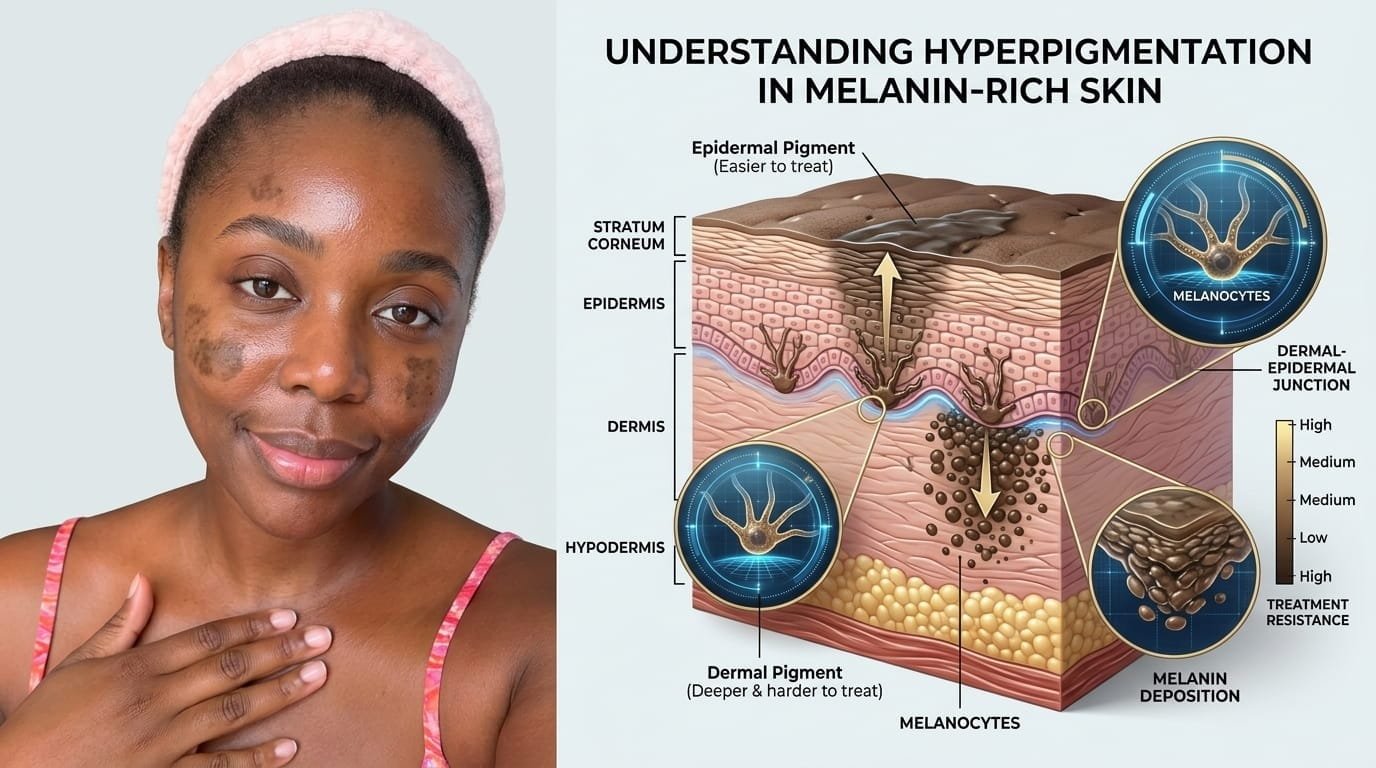
If a dark spot has stayed on your face for months after the pimple, bite, or bump that caused it has healed, you are not imagining it, and you are not alone. On melanin-rich skin, dark marks last far longer than they do on lighter skin, and most of the advice out there was never built with your skin in mind.
Here is what is actually happening, and what helps.
Why dark spots last longer on melanin-rich skin
Melanin-rich skin responds to inflammation differently. When skin is irritated, whether from a breakout, a shave bump, a scratch, or a harsh product, melanocytes (the cells that produce pigment) respond by producing more melanin at that spot. This is called post-inflammatory hyperpigmentation (PIH), and it is significantly more common and often more persistent in individuals with darker skin tones than in lighter skin.^1,2
The result: a mark that outlasts the original problem, sometimes by months. It is not that your skin is more prone to problems. It is that your skin defends itself more visibly than lighter skin does.^2
Nigeria’s heat and humidity add another layer. Higher ultraviolet (UV) exposure stimulates melanocytes (pigment-producing cells) to produce more pigment, while repeated heat, sweating, and friction may prolong skin inflammation in susceptible individuals.^3
A dark spot that might fade quietly in a cooler climate can sit stubbornly in Lagos heat.
The mistake most people make
The instinct, when a dark spot will not budge, is to reach for something strong. Higher-percentage acids, aggressive scrubs, or products that promise to “burn” the spot away.
This usually backfires. Aggressive exfoliation irritates the skin, and irritated melanin-rich skin responds the way we just described: by producing more pigment. You end up treating the spot with something that risks creating a new one.^1,4
This is also why bleaching has never been the answer, however tempting it looks. Skin-lightening agents work by suppressing melanin production broadly rather than targeting only the dark mark, and inappropriate or prolonged use of unregulated bleaching products has been associated with serious skin complications, including exogenous ochronosis, steroid-induced skin damage, and mercury toxicity.^5
Dark spots are not a flaw. They are simply how melanin-rich skin protects itself.
What actually helps
Fading hyperpigmentation on dark skin comes down to three things, none of them dramatic.
Gentleness over force. Ingredients studied for their role in supporting pigment regulation, such as niacinamide, licorice root extract, azelaic acid, and other botanical actives that calm inflammation rather than strip the skin, can help improve uneven pigmentation while reducing the risk of further irritation.^4,6
Daily sun protection. UV exposure is one of the strongest triggers for pigment production. Even existing dark spots can become darker with continued sun exposure, making daily broad-spectrum sunscreen an essential part of managing hyperpigmentation, including in darker skin tones.^3,7
Treating dark spots at night while skipping sun protection during the day undoes much of the progress, especially under Nigeria’s strong year-round sunlight.
Time. Real pigment correction follows the skin’s own renewal cycle. It takes weeks, not days, and it is worth the wait. Studies consistently show that successful treatment of post-inflammatory hyperpigmentation requires patience, consistency, and ongoing prevention of new inflammation.^1,2
How Fade Face Oil supports this process
Fade Face Oil was formulated with this exact behaviour in mind: melanin-rich skin that needs support, not force. It is designed to be used at night, working with the skin’s natural overnight repair cycle rather than against it, to help even tone gradually over time.
It will not fade a dark spot overnight, and we would rather tell you that plainly than promise something we cannot deliver. What it offers is consistency: a gentle, botanical formula built for skin that produces pigment generously, used the way skin like this actually responds, with patience instead of force.
Key Takeaways
- PIH is more common and longer-lasting in melanin-rich skin.
- Harsh treatments often worsen pigmentation.
- Daily sunscreen plus gentle, consistent care gives the best long-term results.
- Improvement is measured in weeks to months, not overnight.
At Marula Green Beauty
We create botanical skincare with deep respect for the skin barrier, ingredient science, and the needs of real skin in our climate. Our formulas are made for people who want visible results without harshness or unnecessary complexity.
The products behind this post
Ready to treat your dark spots the gentle way?
Fade Face Oil is formulated for melanin-rich skin, built to support gradual, lasting results without stripping or irritating the skin. Formulated for African skin. Every shade of it.
References
- Davis EC, Callender VD. (2010). Postinflammatory Hyperpigmentation: A Review of the Epidemiology, Clinical Features, and Treatment Options in Skin of Color. Journal of Clinical and Aesthetic Dermatology, 3(7), 20–31.
https://pmc.ncbi.nlm.nih.gov/articles/PMC2921758/ - American Academy of Dermatology Association. Dark spots and patches (Hyperpigmentation): Causes and treatment.
https://www.aad.org/public/everyday-care/skin-care-secrets/routine/fade-dark-spots - American Academy of Dermatology Association. How to treat dark spots caused by acne.
https://www.aad.org/public/diseases/acne/derm-treat/dark-spots - Grimes PE. Management of Hyperpigmentation in Darker Racial Ethnic Groups. Seminars in Cutaneous Medicine and Surgery.
https://pubmed.ncbi.nlm.nih.gov/19778752/ - World Health Organization. Mercury in skin lightening products.
https://www.who.int/news-room/fact-sheets/detail/mercury-and-health - DermNet NZ. Post-inflammatory hyperpigmentation.
https://dermnetnz.org/topics/postinflammatory-hyperpigmentation - Skin of Color Society. Patient Education Resources.
https://skinofcolorsociety.org/patient
Frequently asked questions
Why do dark spots take longer to fade on black skin?
Melanin-rich skin produces pigment more readily in response to inflammation, a process called post-inflammatory hyperpigmentation (PIH). When skin is irritated, whether from a breakout, a scratch, or a harsh product, melanocytes respond by producing extra pigment at that spot. This is a normal protective response, not a flaw, but it means dark marks can outlast the original problem by months.
Does hyperpigmentation on dark skin ever fully go away?
Often, yes, with gentle and consistent care. Aggressive treatments tend to cause more irritation, which can trigger new pigment rather than fading the old spot. Slower, botanical approaches paired with daily sun protection tend to produce results that last, though timelines vary from person to person.
Is bleaching an effective way to treat dark spots?
Bleaching suppresses melanin production broadly rather than targeting a specific spot, and it does not address why the spot appeared in the first place. It also carries long-term risks to skin health. Gentle, targeted care that supports the skin’s own repair process is a safer route to fading dark spots.
Do I need sunscreen if I have dark skin?
Yes. UV exposure is one of the most direct triggers for pigment production, regardless of skin tone. Skipping daily sun protection while treating dark spots at night can undo much of that progress, especially in Nigeria’s climate.
How long does it take to fade a dark spot on melanin-rich skin?
Real pigment correction follows the skin’s natural renewal cycle, which typically takes several weeks rather than days. Products that promise overnight results on dark spots are usually relying on temporary irritation rather than genuine fading.
What ingredients help fade hyperpigmentation without irritating dark skin?
Botanical, barrier-supporting formulas tend to work with melanin-rich skin rather than against it. Harsh acids and aggressive exfoliants can trigger the same inflammation response that causes dark marks in the first place, so gentler, consistent formulations are generally better suited to this skin type.
Can Fade Face Oil help with dark spots?
Fade Face Oil is formulated for melanin-rich skin and designed to be used at night, working with the skin’s natural repair cycle to help even tone gradually over time. It is built for consistency rather than overnight results.