One of the most common habits in Nigerian skincare conversations is sorting ingredients into two piles: good and bad. Someone hears that an ingredient caused a problem, and it gets added to a mental blacklist, sometimes forever, regardless of context.
The truth is less simple, and more useful. Almost no ingredient is dangerous by nature alone. What determines whether an ingredient helps or harms is concentration, duration of use, the condition of the skin it’s being used on, and whether the product was formulated with proper oversight. The same active that clears a stubborn breakout at the right strength can damage the skin barrier at the wrong one.
This matters more in Nigeria than in many markets, because a meaningful share of skincare here is bought informally, decanted, relabelled, or recommended by word of mouth rather than a dermatologist. That means the context that makes an ingredient safe elsewhere, a measured dose, a defined duration, a professional’s guidance, is often the exact thing missing here.
So instead of asking “is this ingredient bad,” the more useful question is: why is this ingredient in this product, at what strength, and for how long am I meant to use it? Here are four ingredients worth understanding through that lens.
Hydroquinone: What It Is, When It’s Used, and What to Ask
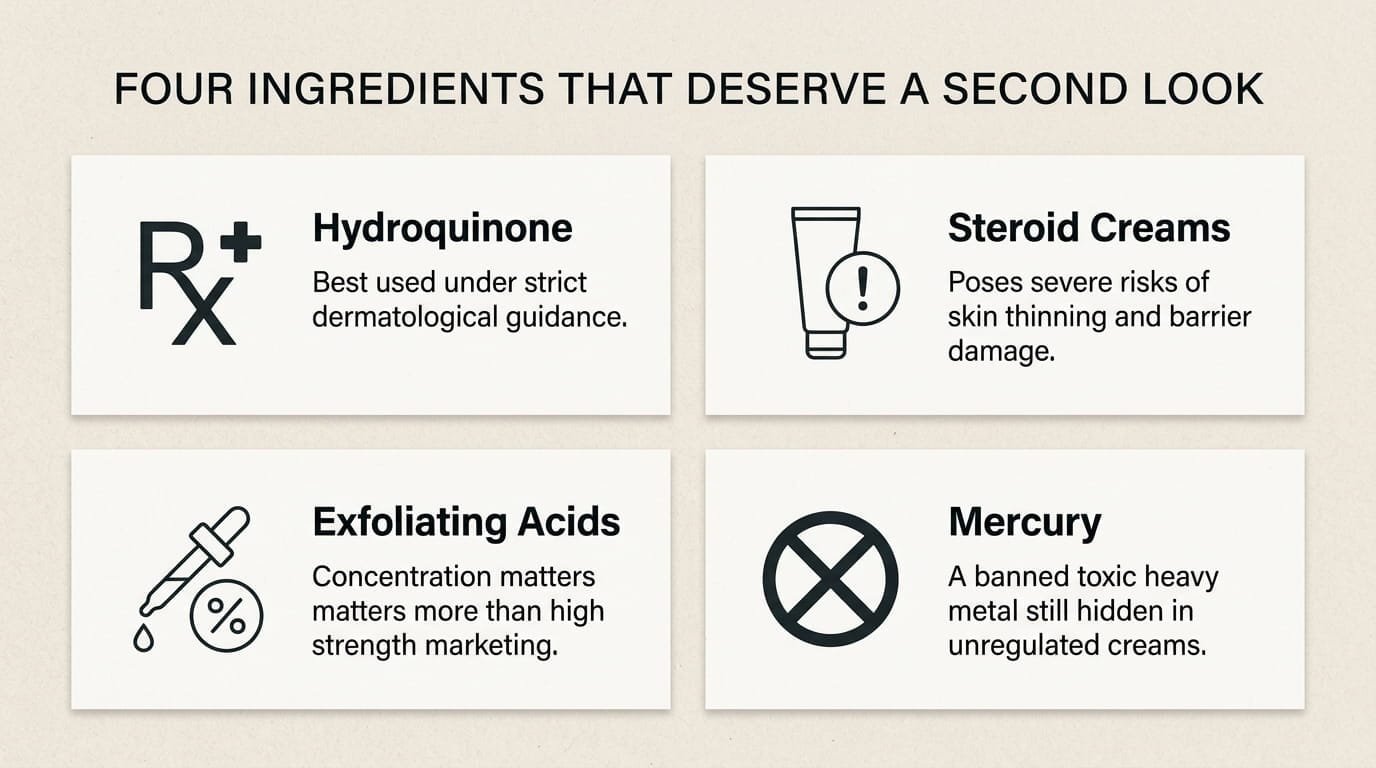
Hydroquinone is a skin-lightening agent with real, established uses in dermatology. It works by inhibiting the enzyme responsible for melanin production, which is why it’s prescribed for stubborn hyperpigmentation and melasma under medical supervision.
The concern in the Nigerian market isn’t the molecule itself. It’s how it circulates outside of that clinical context: sold loose, in unlabelled jars, at concentrations nobody has measured, for however long the buyer decides to continue. Used this way, without a defined endpoint, hydroquinone is associated with skin complications that are considerably harder to treat than the dark spot it was meant to fade.
Before using a product containing hydroquinone, worth asking: What concentration is actually in this? Is it meant for short-term, targeted use, or has it been marketed as a daily, indefinite treatment? Has anyone explained how long is considered safe?
Steroid Creams: A Common Substitution With a Real Cost
Topical corticosteroids are formulated to calm specific, diagnosed inflammatory skin conditions, eczema, psoriasis, certain rashes, for a short, supervised period, often just a few weeks.
In parts of the informal skincare market, these creams get repurposed for an entirely different job: everyday brightening or smoothing, used continuously, sometimes for years. This is a substitution the product was never designed for. Prolonged, unsupervised steroid use is linked to thinning of the skin barrier over time, along with increased sensitivity and a heightened risk of the very issues, uneven tone, visible veins, irritation, the product was being used to avoid.
Worth asking: Was this cream actually prescribed for a diagnosed condition, or picked up as a general skincare product? Do I know what continuous, unsupervised use does to skin over time?
Exfoliating Acids: Why Concentration Matters More Than Marketing
AHAs (like glycolic and lactic acid) and BHAs (like salicylic acid) are genuinely effective at improving texture, tone, and clarity when used at appropriate strengths and frequencies. They are not the problem. The problem is the assumption that a higher percentage or more frequent use automatically means better, faster results.
For melanin-rich skin specifically, over-exfoliation carries a particular risk. Aggressive or overly frequent acid use irritates the skin, and irritated melanin-rich skin tends to respond by producing more pigment at the site of that irritation, a process called post-inflammatory hyperpigmentation. In other words, an acid used too aggressively to fade a mark can end up creating a new one.
Worth asking: Am I using the concentration and frequency my skin genuinely tolerates, or the strength that markets the most aggressively? Is my skin showing signs of irritation, tightness, or new sensitivity that I’ve been ignoring because I expected some discomfort as “proof it’s working”?
Mercury: Officially Banned, Still Present
Mercury compounds have been banned in skin-lightening products in most markets, including Nigeria, for a long time. Despite this, mercury still turns up in some informally sold and imported lightening products, occasionally listed under unfamiliar chemical names rather than the word “mercury” itself.
Mercury accumulates in the body over time rather than being fully eliminated, which is part of why unsupervised, long-term exposure through skin products is treated as a serious concern by health authorities.
Worth asking: Do I recognise every ingredient name on this label? If a name is unfamiliar, have I looked it up before purchasing, rather than after a problem appears?
Five Questions to Ask Before Buying Any Skincare Product
Before checkout, whether online or in an informal market, it’s worth running through a short checklist:
- Do I know what every ingredient on this label actually is?
- Do I know the concentration, or at least whether it’s within a range considered standard for this ingredient?
- Was this product formulated and labelled by a traceable source, or sold loose without documentation?
- Is this meant for short-term, targeted use, or ongoing daily use, and does the packaging tell me which?
- Am I choosing this because I understand what it does, or because someone told me it works?
At Marula Green Beauty
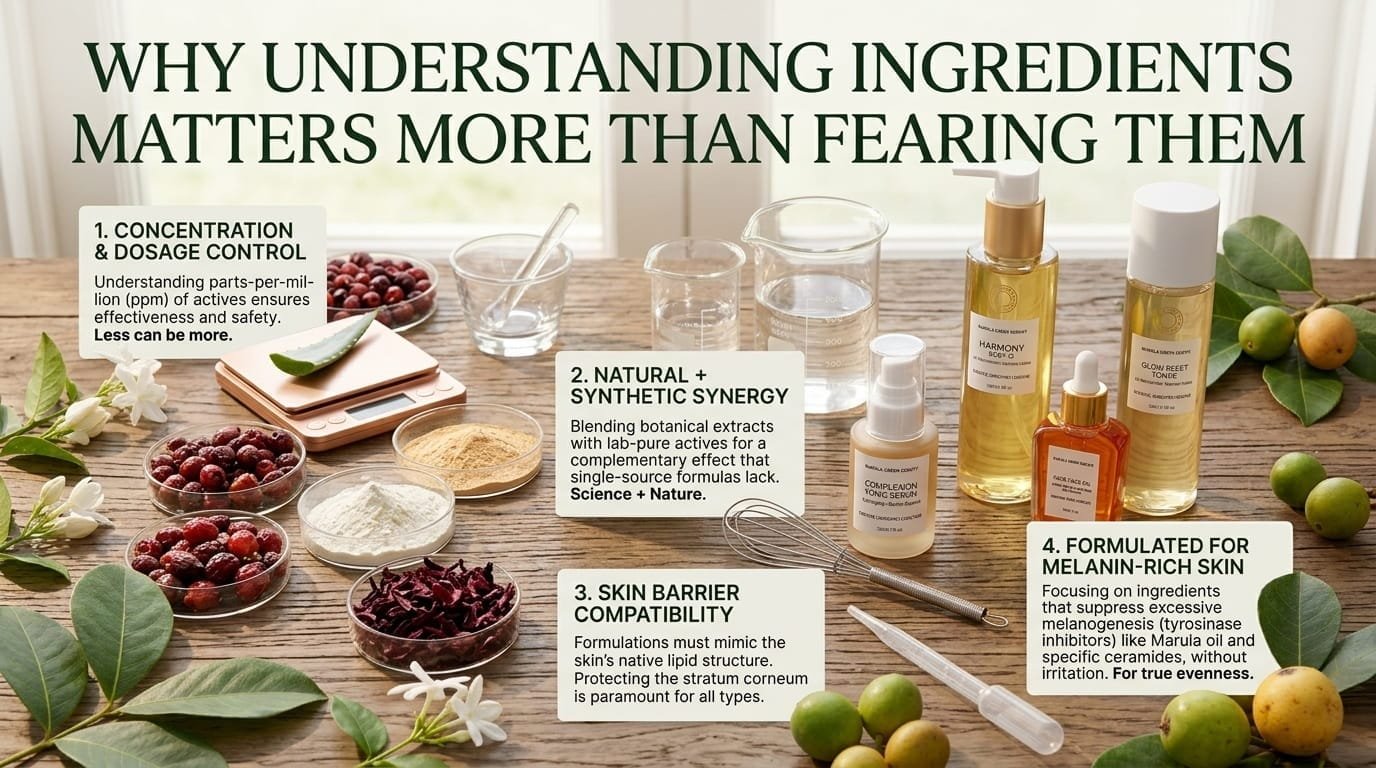
We create botanical skincare with deep respect for the skin barrier, ingredient science, and the needs of real skin in our climate. Our formulas are made for people who want visible results without harshness or unnecessary complexity.
Formulated With Intention
Every active in the Marula Green Beauty range is chosen deliberately, at a strength meant for melanin-rich skin, rather than adjusted from a formula built for someone else’s skin. Explore Fade Face Oil and the Complexion Tonic Serum to see this approach applied.
References
An Update on the Safety of Hydroquinone. A 2024 review summarising hydroquinone’s effectiveness, appropriate use, adverse effects, and why supervision matters when treating hyperpigmentation. Archives of Dermatological Research.
https://pmc.ncbi.nlm.nih.gov/articles/PMC10723018/
Exogenous Ochronosis Associated with Hydroquinone: A Systematic Review. Reviews reported cases of hydroquinone-associated exogenous ochronosis and concludes that most cases were linked to prolonged or inappropriate use rather than short-term supervised treatment.
https://pubmed.ncbi.nlm.nih.gov/34486734/
Quality Assessment of Hydroquinone, Mercury and Arsenic in Skin-Lightening Cosmetics Marketed in Ilorin, Nigeria. A Nigerian study that found some products exceeded permitted hydroquinone levels and highlighted the need for stronger consumer awareness and regulatory enforcement. Scientific Reports.
https://pmc.ncbi.nlm.nih.gov/articles/PMC10615531/
Nigerian study of skin-lightening cosmetics https://pubmed.ncbi.nlm.nih.gov/
Lagos epidemiological survey https://pubmed.ncbi.nlm.nih.gov/
Frequently asked questions
Are all skin-lightening ingredients unsafe?
No. Some, like hydroquinone, have legitimate medical applications under supervision. The risk comes from unsupervised, unmeasured, indefinite use, not from the existence of the ingredient.
How do I know if a skincare product is safe for daily use?
Check whether the packaging specifies duration and frequency of use, and whether the ingredient list and concentrations are disclosed. Products without this information are harder to use safely, regardless of what’s actually inside them.
Why is melanin-rich skin more affected by harsh ingredients?
Melanin-rich skin tends to respond to irritation and inflammation by producing more pigment at the affected site, which is why aggressive treatments can result in new dark marks rather than fewer.
Is it safe to use products bought without clear labelling?
Products without clear labelling make it difficult to know the concentration or safety profile of what you’re using, which is one of the biggest risk factors described in this article.