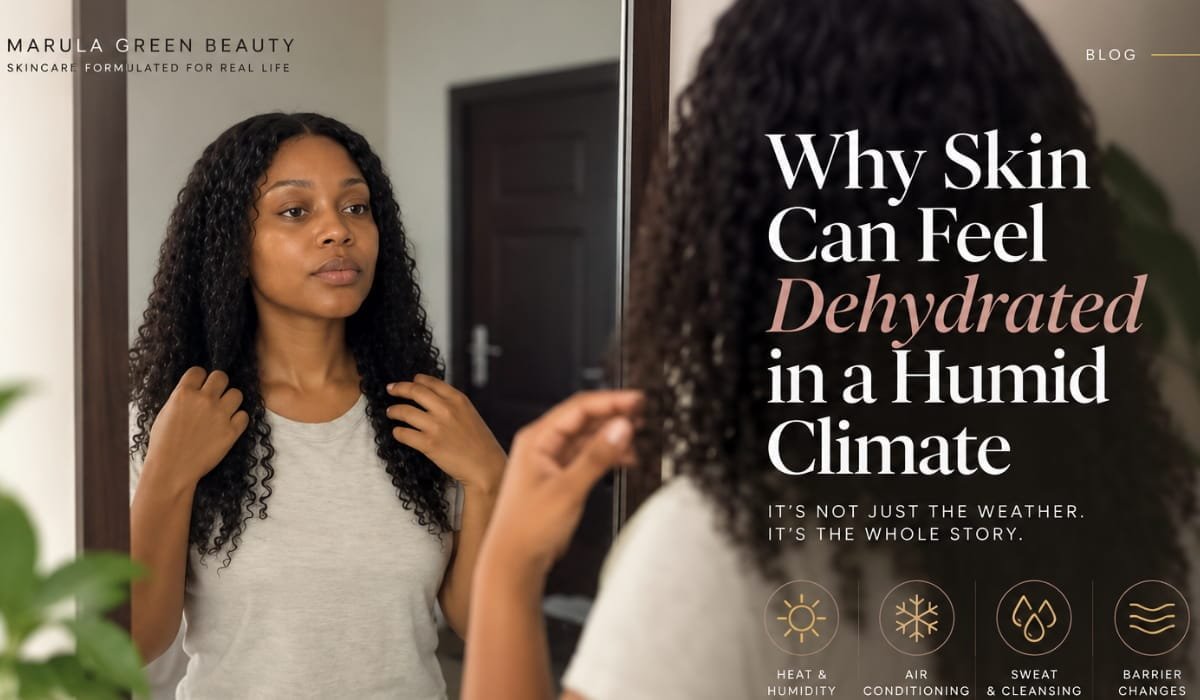
If you live in Lagos, you probably know the feeling.
You step outside and the air feels heavy. Your face starts to shine. By midday, you are blotting oil from your forehead and nose.
So why, by evening, can your skin still feel tight?
It seems contradictory. If the air is humid, shouldn’t your skin be hydrated?
Not necessarily. Humidity is one part of the environment your skin interacts with, but it isn’t the only thing determining how much water your skin contains, or how well it holds on to that water.
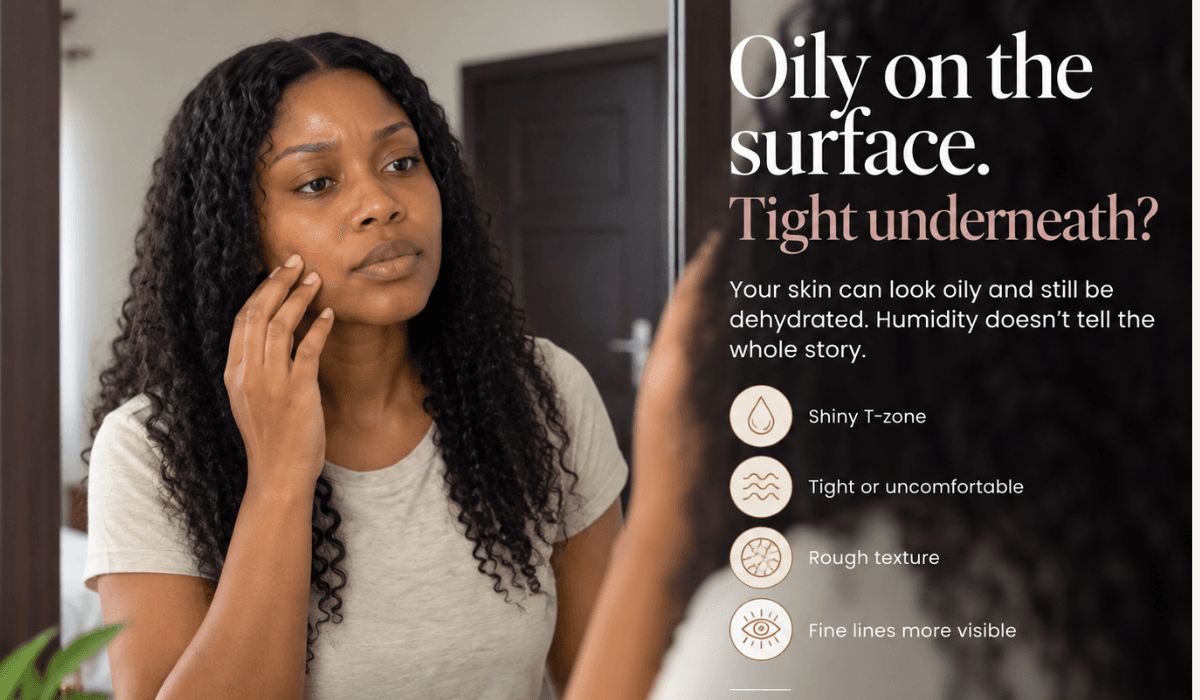
That distinction matters, because you can have oily-looking skin that still feels dehydrated.
What “dehydrated skin” actually means
Dehydrated skin refers to skin with reduced water content.
It is different from dry skin. Dry skin generally describes a skin type or tendency associated with insufficient lipids. Dehydration is a state, which means any skin type can experience it, including oily skin.
Your skin barrier plays a major role here. The outermost layer of your skin, the stratum corneum, helps regulate water movement between your body and the environment. Water is constantly moving through the skin, and the barrier helps control that loss, a process commonly measured as transepidermal water loss, or TEWL.
So healthy hydration isn’t simply about putting more water onto your face. It is also about your skin’s ability to hold on to water.
Signs your skin may be dehydrated
Dehydration can look different from person to person, but common signs include:
- skin that feels tight after cleansing
- a dull or tired-looking complexion
- fine lines that seem more visible than usual
- skin that feels oily and uncomfortable at the same time
- products you normally tolerate feeling less comfortable
None of these on its own confirms dehydration, but together they are worth paying attention to.
Humidity doesn’t automatically mean hydrated skin
The relationship between humidity and skin is more complicated than “humid air is bad for skin” or “humid air hydrates skin.”
Ambient humidity can influence skin hydration and barrier function, and studies have found that higher humidity can increase water content in the stratum corneum. But humidity is only one factor, and it rarely acts alone.
In other words, the humidity outside your skin doesn’t tell you everything about what is happening on it.
Think about a typical day in Lagos. You may move between:
- hot, humid outdoor air
- air-conditioned offices and cars
- indoor spaces with fans
- hot showers
- frequent face washing, especially after sweating
- repeated wiping or blotting
- products containing potentially irritating ingredients
Your skin isn’t experiencing “Lagos humidity” in isolation. It is experiencing a series of changing environments and habits.
Your air conditioner may be part of the story

If you spend much of your day indoors, this is particularly relevant.
Air-conditioned environments can have lower humidity than outdoors, depending on the system and conditions. Studies have linked low-humidity environments with changes in stratum corneum hydration, skin roughness and barrier function.
So you can leave the house in humid air, spend eight hours in an air-conditioned office, sit in an air-conditioned car on the way home, and then wonder why your skin feels tight.
The weather app may say humid. Your skin may be telling you something different.
Then there’s sweat
In hot weather, your skin may produce more sweat, and your face may look dewy or oily.
But surface wetness is not the same as properly hydrated skin. Sweat sitting on the surface doesn’t mean your barrier is functioning well, or that the stratum corneum is holding the water it needs.
And once you start reacting to that sweaty, shiny feeling by washing more often or reaching for more aggressive products, you can create another problem.
The instinct to strip the skin
When skin looks oily, the instinct is to remove the oil. So the routine becomes:
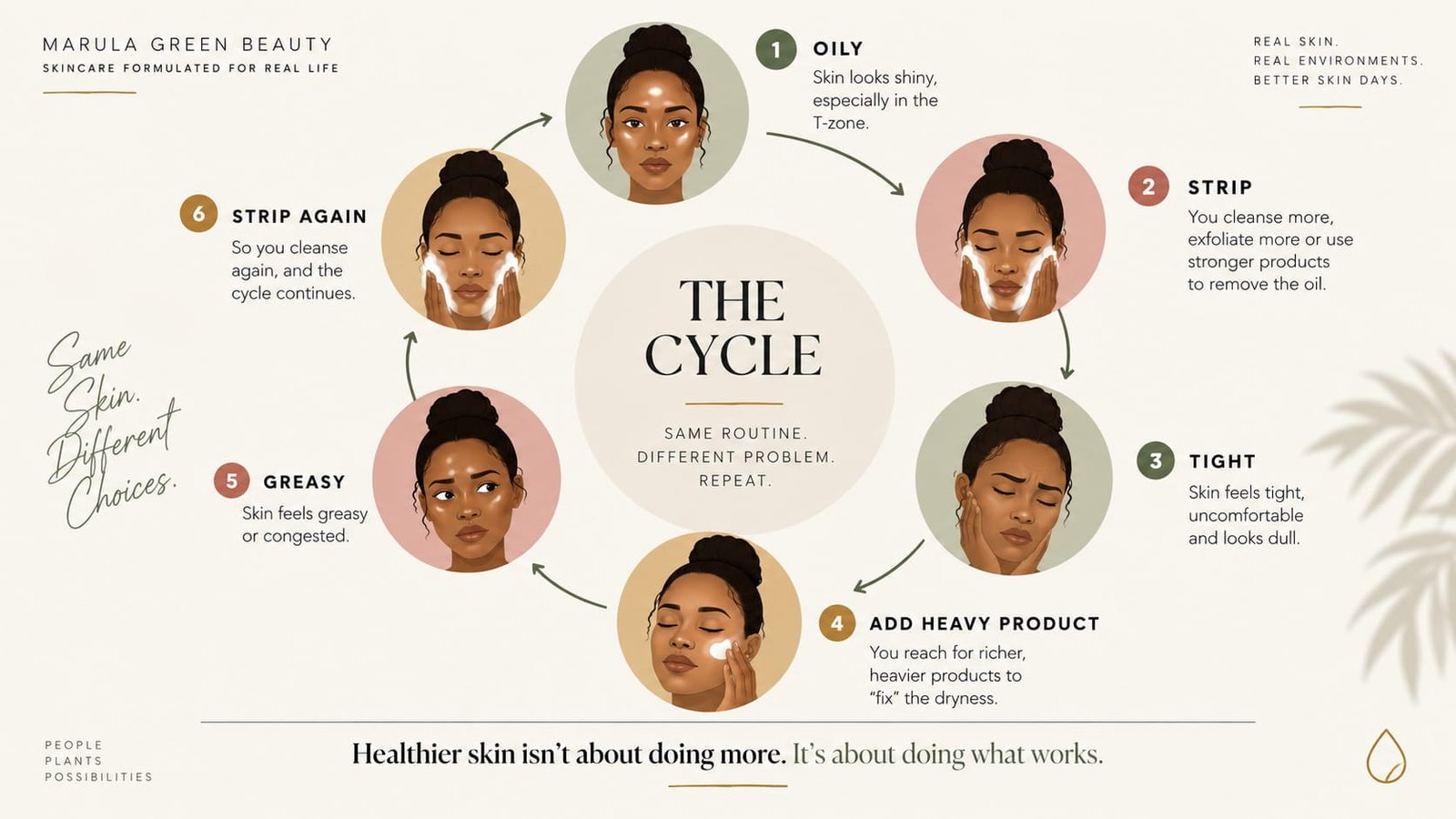
more cleansing → more exfoliation → stronger products → more cleansing
For a while, skin may even feel cleaner. But “squeaky clean” isn’t the same as healthy.
Harsh cleansers, astringents and aggressive exfoliation can disrupt the skin barrier. When the barrier is compromised, water loss and irritation become part of the problem.
This creates a frustrating cycle.
Your skin feels oily. You assume it needs to be stripped. You strip it. It feels tight. You interpret the tightness as dryness. You add something heavy. Now your skin feels greasy. So you strip it again.
And suddenly you are using six products to solve a problem your routine may be contributing to.
Hydration and oil are not the same thing
This is where the difference between water and lipids matters.
A hydrated barrier needs water, but it also needs the structures that help retain it. The stratum corneum relies on natural moisturising factors inside its cells, alongside intercellular lipids that help regulate water loss.
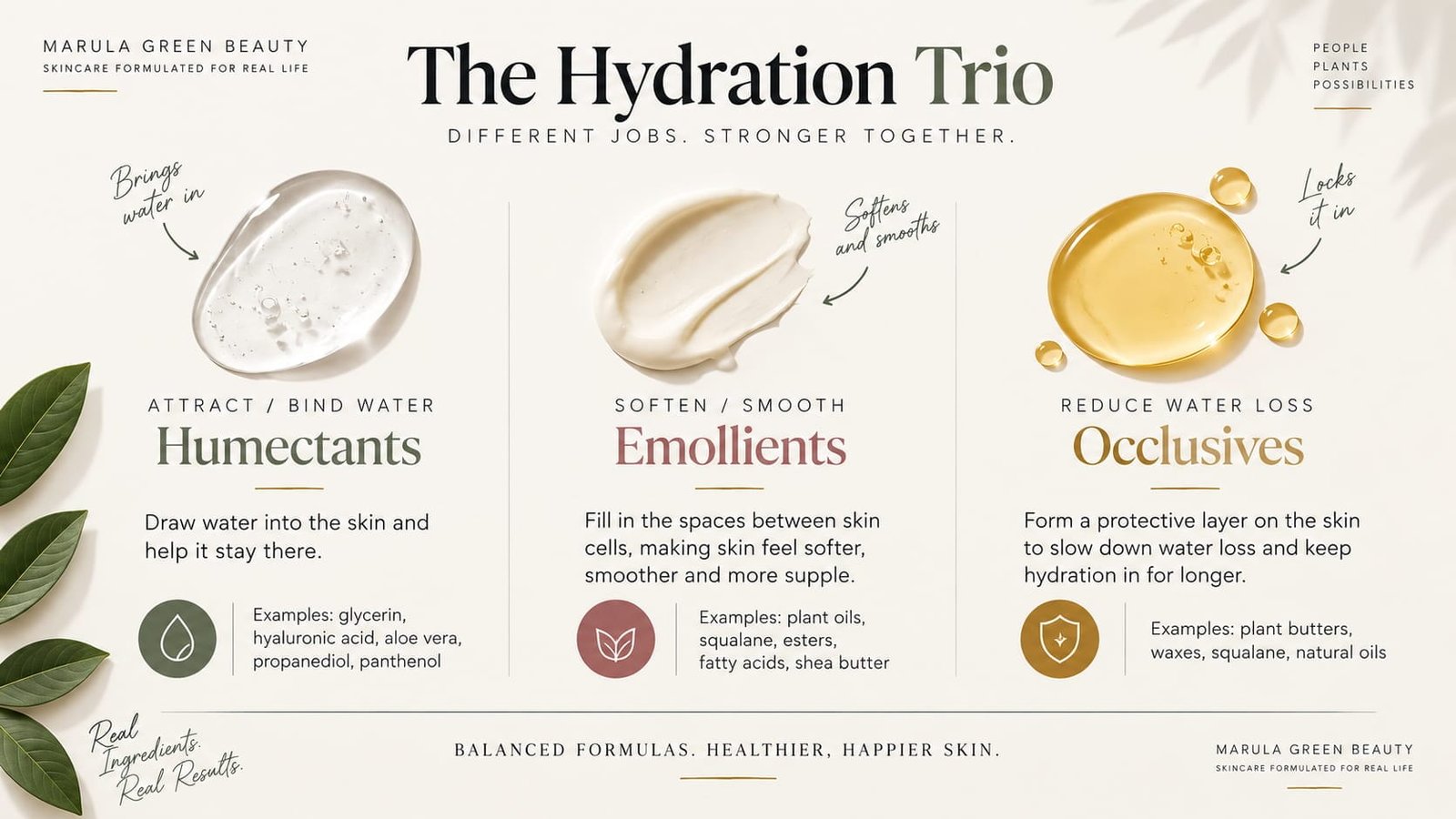
This is why “hydrating” and “moisturising” aren’t interchangeable.
Humectants attract and bind water. Common examples include glycerin, sodium hyaluronate, panthenol and beta-glucan.
Emollients help soften and smooth the skin.
Occlusives help reduce water loss by forming a layer at the skin’s surface.
Good skincare doesn’t necessarily choose one category. It considers what the skin needs and how those ingredients work together. An oil can support the skin’s lipid environment, but on its own it doesn’t add water.
Why this matters more for melanin-rich skin
On melanin-rich skin, irritation carries an extra cost. Inflammation can trigger post-inflammatory hyperpigmentation, and PIH has a heightened prevalence in darker skin tones.
So treating dehydration gently isn’t only about comfort. It is also part of protecting an even-looking tone.
What to do differently in a humid climate
The answer isn’t a more complicated routine. It is paying closer attention to what your skin is actually doing.
Cleanse gently. If your skin is oily but feels tight, ask whether your cleansing is too aggressive. A cleanser should leave skin comfortable, not squeaky.
Question your exfoliation. If you exfoliate frequently, ask whether your skin actually needs that much.
Use humectants and barrier support. If your skin feels dehydrated, look for humectants and barrier-supportive ingredients rather than assuming the answer is simply more oil.
Don’t skip moisturiser because your skin is oily. Oily skin still benefits from water being held in place. A lightweight texture suited to heat is usually a better choice than skipping it.
Choose textures you’ll actually wear. In heat and humidity, heavy products often get abandoned by midday. The routine that works is the one your skin tolerates and you keep using.
Wear sunscreen daily. Sun exposure can worsen pigmentation, so daily broad-spectrum sunscreen is an important part of protecting the progress you are making with the rest of your routine.
And don’t confuse shine with hydration. A shiny face can still be uncomfortable. A face that produces oil can still need water.
The takeaway
Living in a humid climate doesn’t automatically mean your skin is hydrated. It can look shiny and still lack water.
Sometimes the solution isn’t another product designed to remove oil. It is supporting hydration, protecting the barrier, and removing some of the things making your skin work harder than it needs to.
So the next time you look at your face halfway through a hot Lagos day and wonder why you are oily and still tight, don’t immediately reach for the stronger cleanser.
Start with a better question: what is my skin actually asking for?
Frequently asked questions
Can oily skin be dehydrated?
Yes. Oily skin refers to higher sebum production, while dehydration refers to reduced water content. They can occur at the same time.
Does humid weather hydrate your skin?
Not automatically. Higher humidity can increase water content in the outer skin layer, but hydration also depends on your barrier, your environment and your skincare habits.
Does air conditioning dry out skin?
Air conditioning can lower indoor humidity, and low-humidity environments have been linked with reduced skin hydration and barrier function. Long hours in air-conditioned spaces may leave skin in drier conditions than the weather outside suggests.
Why does my skin feel tight after cleansing?
It can be a sign your cleansing routine is too drying or irritating for your skin, though the sensation alone doesn’t confirm the cause.
Should I use facial oil if my skin is dehydrated?
An oil can provide emollience and support the skin’s lipid environment, but it doesn’t replace water. A hydration-focused routine can combine humectants, emollients and barrier-supportive ingredients.
Why does my skin get oily in Lagos but still feel dry?
Heat can increase sweating and the appearance of oiliness, while cleansing habits, air conditioning and barrier disruption can contribute to tightness or dehydration. The combination can make oily and dehydrated skin occur together.
Built for skin in this climate

Our Glow Reset Toner was formulated with this in mind. It combines 4% niacinamide with humectants including propanediol, glycerin, beta-glucan and sodium hyaluronate, in a lightweight texture designed to sit comfortably in Nigeria’s heat and humidity.
Shop the Glow Reset TonerReferences
- Verdier-Sévrain S, Bonté F. Skin hydration: a review on its molecular mechanisms. J Cosmet Dermatol. 2007;6(2):75-82.
- Engebretsen KA et al. The effect of environmental humidity and temperature on skin barrier function and dermatitis. J Eur Acad Dermatol Venereol. 2016;30(2):223-49.
- Goad N, Gawkrodger DJ. Ambient humidity and the skin: the impact of air humidity in healthy and diseased states. J Eur Acad Dermatol Venereol. 2016;30:1285-94.
- Green M et al. Transepidermal water loss (TEWL): Environment and pollution—A systematic review. Skin Health Dis. 2022;2(2):e104.
- Ananthapadmanabhan KP et al. Cleansing without compromise: the impact of cleansers on the skin barrier and the technology of mild cleansing. Dermatol Ther. 2004.
- Mar K et al. Treatment of Post-Inflammatory Hyperpigmentation in Skin of Colour: A Systematic Review. J Cutan Med Surg. 2024;28(5):473-480.
- Green M et al. “Normal” TEWL—how can it be defined? A systematic review. Exp Dermatol. 2022;31(10):1618-1631.

About the Author
Chioma Adagbusi | Founder & Skincare Formulator, Marula Green Beauty
Chioma is the founder and skincare formulator behind Marula Green Beauty, a Nigerian botanical skincare brand creating thoughtful formulations for melanin-rich skin and the realities of the African climate. Her approach combines botanical ingredients, formulation science and a barrier-conscious philosophy.