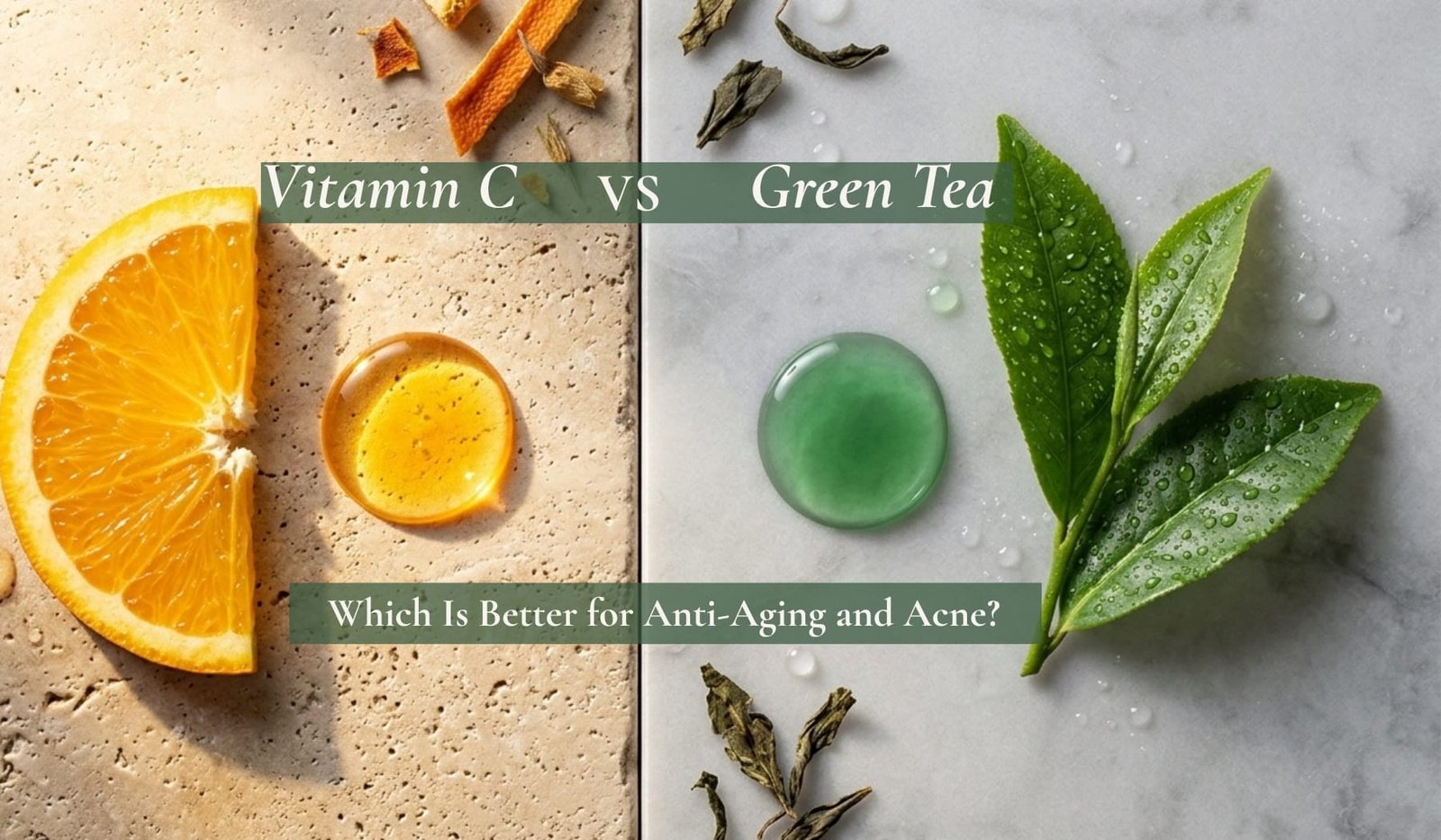
When it comes to botanical skincare, two ingredients are praised again and again for their antioxidant power: Vitamin C and Green Tea.
Both are used for dullness, uneven tone, early signs of aging, oiliness, and acne-prone skin. But they do not work in the same way.
Vitamin C is best known for brightening, supporting collagen, and improving the look of uneven tone. Green Tea, through its key catechin EGCG, is better known for calming, antioxidant protection, oil-control support, and soothing skin that is prone to inflammation.
So which one is better?
The honest answer is that it depends on what your skin needs most. This article breaks down what the research actually says, so you can choose with confidence.
Why antioxidants matter in skincare
Every day, your skin is exposed to sunlight, pollution, heat, and lifestyle stress. In Nigeria’s heat and humidity, that load adds up quickly. These stressors contribute to oxidative stress, which plays a role in premature aging, dullness, uneven tone, and inflammation.
Antioxidants help protect the skin by neutralizing free radicals before they cause visible damage.
This is where Vitamin C and Green Tea earn their reputation. They do not replace sunscreen, a good cleanser, or a consistent routine, but they support healthier-looking, more resilient skin when used correctly.
Vitamin C for dark spots and anti-aging
Vitamin C is one of the most researched antioxidants in skincare. A dermatology review in the Journal of Clinical and Aesthetic Dermatology describes topical Vitamin C as having antioxidant, photoprotective, anti-aging, and anti-pigmentary benefits, and notes that it supports collagen and helps reduce melanin formation, which is why it is so often used for dark spots and uneven tone.[1] A separate review describes the same collagen and antioxidant roles, including protection against UV-induced photodamage.[2]
Vitamin C is strongest when your main concern is dullness, early signs of aging, uneven tone, dark spots, or post-acne marks. It supports collagen, helps improve the look of fine lines and firmness, and brings back radiance.
For acne-prone or sensitive skin, the form matters. Pure L-ascorbic acid can feel too strong for some skins. Gentler derivatives like Sodium Ascorbyl Phosphate (SAP) and Magnesium Ascorbyl Phosphate (MAP) are often more comfortable. One study found that 5% sodium L-ascorbyl-2-phosphate worked as a standalone treatment for acne, and another reported that SAP showed antimicrobial activity against P. acnes and helped prevent sebum oxidation.[3][4]
Green Tea for oily and acne-prone skin
Green Tea comes from the leaves of Camellia sinensis. In skincare it is valued for its polyphenols, especially EGCG, which has antioxidant, soothing, and oil-balancing potential. It is a favourite for oily, acne-prone, reactive, or easily inflamed skin.
A review of human studies found some evidence that topical tea polyphenols may help reduce sebum and support acne-prone skin, while noting that larger, higher-quality studies are still needed.[5] That caveat matters: Green Tea is promising, not a guaranteed cure.
The research is still encouraging. The same review reports that a 5% green tea topical reduced sebum secretion by 27% at day 60 in one small study, and that a split-face trial found 1% EGCG reduced non-inflammatory lesions by 79% and inflammatory lesions by 89% after eight weeks, though both studies were small.[5]
This is exactly why our Glow Reset Toner leans on Green Tea. It is built to support oily, breakout-prone skin without stripping it.
The best choice isn’t the stronger ingredient — it’s the one that matches what your skin needs most.
Vitamin C vs Green Tea: which is better?
The best choice depends on your main concern.
Vitamin C
Dullness, fine lines, uneven tone, dark spots, or post-acne marks. The stronger choice for brightening and radiance.Green Tea
Oiliness, redness, inflamed breakouts, or sensitive skin. The stronger choice for calming and oil control.Best for post-acne marks
If the marks left behind after breakouts are your main concern, reach for Vitamin C, especially gentler forms like SAP or MAP. Green Tea can calm the environment that causes breakouts, but Vitamin C is better suited to improving the appearance of the marks themselves. This is the work our Complexion Tonic Serum is designed for: uneven tone and post-acne marks, quietly, over time.
Can you use Vitamin C and Green Tea together?
Yes. You do not have to choose one. Both can sit in a well-designed routine, especially when your concerns overlap, like acne plus post-acne marks, or aging plus sensitivity. A simple approach:
- Vitamin C
- Moisturizer
- Sunscreen
- Green Tea product
- Barrier moisturizer or oil
This gives your skin antioxidant support during the day and calming support at night. If your skin is sensitive, introduce one ingredient at a time so you can tell what it likes.
Usage tips
- Introduce one new product at a time.
- Patch test if your skin is sensitive.
- Use Vitamin C in the morning if your skin tolerates it.
- Use Green Tea when your skin feels oily, inflamed, or reactive.
- Wear sunscreen daily, especially when treating dark spots and post-acne marks.
- Be consistent — antioxidants work best as part of a routine.
Frequently asked questions
Can I use Vitamin C and Green Tea together?
Yes. They work well in the same routine when the products are well-formulated and your skin tolerates them. A simple approach is Vitamin C in the morning and Green Tea in the evening.
Is Green Tea better than Vitamin C for acne?
Green Tea may be better for oily, inflamed, or sensitive acne-prone skin. Vitamin C is usually better for post-acne marks, dullness, and uneven tone.
Is Vitamin C good for acne scars?
Vitamin C can improve the look of post-acne marks and uneven tone, and supports collagen, which matters for repair. Deeper acne scars usually need professional treatment.
What type of Vitamin C is best for acne-prone skin?
Sodium Ascorbyl Phosphate and Magnesium Ascorbyl Phosphate are often gentler options for acne-prone or sensitive skin.
Is Green Tea good for oily skin?
Yes, it is worth considering. Some studies suggest topical Green Tea may help reduce sebum, though more high-quality research is still needed.
Do Vitamin C and Green Tea replace sunscreen?
No. Antioxidants support the skin but do not replace sunscreen. Daily sunscreen is essential when treating aging signs, dark spots, or post-acne marks.
At Marula Green Beauty
We create botanical skincare with deep respect for the skin barrier, ingredient science, and the needs of real skin in our climate. Our formulas are made for people who want visible results without harshness or unnecessary complexity.
Explore our botanical skincare built to support dull, uneven, and tired-looking skin with care that was made for it.
The products behind this post
The ingredients discussed in this post are found in our Complexion Tonic Serum and Glow Reset Toner – formulated for African skin. Shop the productsReferences
- Topical Vitamin C and the Skin: Mechanisms of Action and Clinical Applications. Journal of Clinical and Aesthetic Dermatology. jcadonline.com
- The Roles of Vitamin C in Skin Health. Pullar et al. pmc.ncbi.nlm.nih.gov
- Sodium L-ascorbyl-2-phosphate 5% lotion for the treatment of acne vulgaris. Woolery-Lloyd et al. pubmed.ncbi.nlm.nih.gov
- Sodium ascorbyl phosphate shows in vitro and in vivo activity against P. acnes. Klock et al. pubmed.ncbi.nlm.nih.gov
- Green Tea and Other Tea Polyphenols: Effects on Sebum Production and Acne Vulgaris. Saric et al. mdpi.com